
Generative Engine Optimization (GEO) is the process of making content and online presence better so that a brand or website is more likely to be found, mentioned and shown in responses created by artificial intelligence. Unlike SEO, which mainly aims to get webpages to appear higher in search engine results, GEO looks at how artificial intelligence systems understand, find, put together and share information when answering questions.
GEO has become more important as AI tools that search and talk with people have grown. It is about making content that’s easy to understand, reliable, organized and helpful so that AI systems can use it when they create answers.
GEO is connected to ideas like AI Optimization (AIO) and Answer Engine Optimization (AEO). Even though these methods are similar they usually focus on making content work better for intelligence and for getting answers from search engines.
The idea of GEO started when generative AI became more part of regular search engines and systems that find information. As people ask AI tools for answers by looking at many search results, companies and marketing people are changing how they make content to stay seen in this new way of searching online.
Search is evolving fast.
Search is no longer about traditional search engine results. People are turning more and more to AI tools that give quick chat‑like answers.
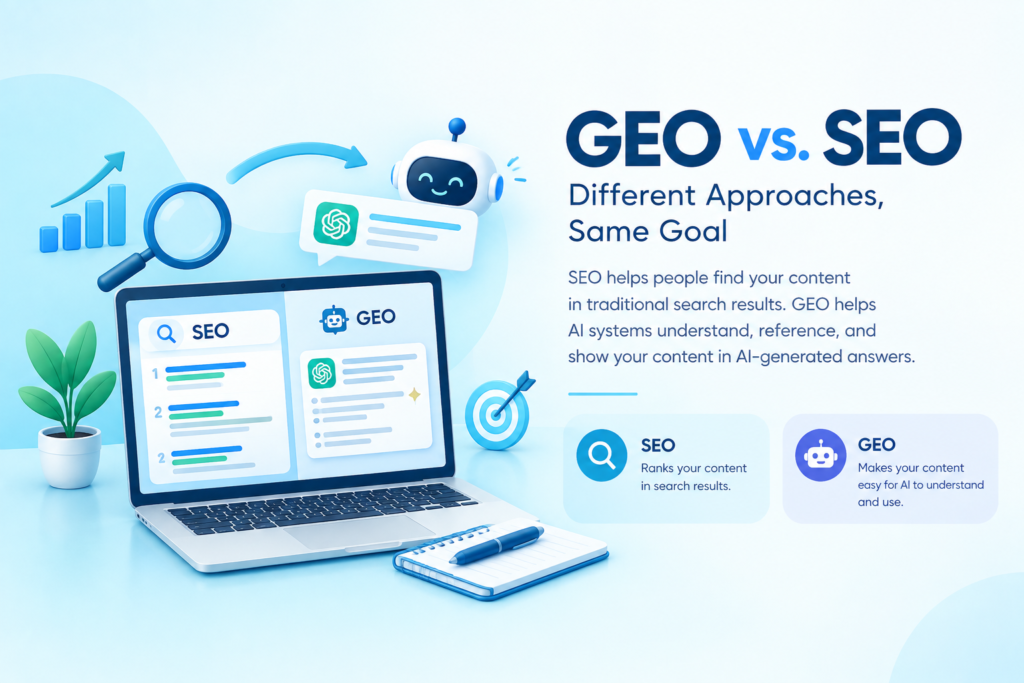
Search Engine Optimization or SEO is about making your content easier to find and higher up in classic search engines like Google.
Generative Engine Optimization or GEO is about shaping your content so that AI systems can read, pull and possibly quote it in answers from tools like ChatGPT, Perplexity and Google AI Overviews.
In terms:
SEO helps people locate your website when they search online.
GEO makes your content a handy source for answers created by AI.
As search keeps changing, blending SEO basics, with content built for AI discovery can help businesses keep up with new ways that people look for information.
SEO and GEO are similar because both like high‑quality, well‑structured and authoritative information.
Here is where SEO and GEO intersect specifically:
Quality standards are vital: Both Google and LLMs aim to deliver high‑quality information that meets users’ needs, expectations and preferences.
Structured content is more likely to be referenced: Clear headings, bullet points, FAQs and an organized layout make it easier for both search engines and AI systems to understand and process your content.
Topical authority can boost visibility: Publishing groups of relevant, high‑quality and linked content can improve your visibility in search engine results. Raise the chance of being referenced by AI systems.
Original research is valuable: Unique data and original research can bring backlinks for SEO. Increase the chance of citations in AI‑generated responses.
Clear answers work well: Short direct answers can do well in featured snippets and AI‑generated summaries.
Overall strong SEO fundamentals give a base for GEO. Creating trustworthy and well‑organized content can keep your brand visible, as search changes
SEO vs. GEO: Differences
| Category | SEO | GEO |
| Search output | SERP with ranked links | AI-generated text answers |
| Search engine type | Traditional (Google, Bing) | Generative (ChatGPT, Perplexity, Gemini) |
| Query format | Short, keyword-based | Longer, more conversational prompts |
| Optimization target | Higher rank in search results | Inclusion or citation in AI-generated responses |
| Content delivery | User clicks through to your page | AI summarizes or paraphrases your content inside its answer |
| Success metrics | Clicks, traffic, rankings, bounce rate | Citations, mentions, and share of voice |
| Content update needs | Evergreen content can stay ranked for years | Content must stay fresh and authoritative to remain cited |
What Are the Goals of GEO?
The main purpose of Generative Engine Optimization is to help AI‑powered search systems find, understand, trust and cite your content when they create answers to users questions.
Here are some of the goals of GEO:
– Increase AI visibility: GEO helps your brand and content become more visible in AI‑generated answers on platforms such as ChatGPT, Google AI Overviews and Perplexity.
– Earn citations and mentions: GEO encourages you to create authoritative content that AI systems can see as a useful source and might reference or link to in their responses. OpenAI for example explains that ChatGPT Search provides links to web sources.
– Build brand authority: Consistently publishing useful original and trustworthy information can strengthen your brands presence across both traditional and AI‑driven search experiences.
– Provide direct answers to user questions: GEO aims to make important information easy for AI systems and people to find. Clear answers, descriptive headings, FAQs, supporting evidence and logical content structures can make information easier to understand.
– Reach users beyond search results: AI‑powered search can introduce websites to users through generated answers and supporting links creating another pathway for people to discover a brand or website.
– Strengthen topical authority: Creating comprehensive content around a specific subject can help establish your website as a useful resource instead of relying on individual isolated articles.
– Improve content quality and originality: Google’s current guidance emphasizes unique valuable, people‑first content and warns against creating large amounts of generic content simply to influence AI responses.
– Support conversions: Greater visibility can create additional opportunities for users to visit your website explore your content become leads, subscribe or make a purchase. Google notes that generative AI features can create opportunities to reach people who may engage with content or convert.
GEO vs. SEO: Input Signals, Ranking Logic and Measurement
1. Input Signals: Keywords vs. Prompts
Keywords are the foundation of all SEO (Search Engine Optimization) strategies. They inform SEO professionals about the words and phrases people use to find specific information on the Internet.
With the rise of generative AI, GEO (generative AI optimization) has emerged. Unlike traditional SEO, GEO focuses on the prompts and questions people use to interact with AI technologies.
For traditional SEO, including the relevant keywords in a webpage allows search engines to understand the topic of the webpage.
SEO and GEO will continue to overlap and inform each other. For the foreseeable future, both will remain necessary for online content to be easily discoverable on the Internet. Keywords may appear in areas such as:
– Page titles and title tags
– Headings
– Meta descriptions
– Body content
– Image alt text and other contextual elements
However modern SEO is not simply about repeating keywords. Search engines are looking more and more at the relevance, quality, usefulness and context of a page.
In GEO the focus changes to making content that can give reliable answers to questions that people ask in a natural way. Keyword placement still has value because AI‑powered search systems need to understand what GEO content is about but optimizing for keyword frequency is not enough.
How to Optimize Content for AI Prompts
To make content easier for AI‑powered systems to understand and potentially reference:
– Answer expected questions Give concise answers before expanding with supporting details.
Use FAQs: Include questions that people ask often with clear facts and answers that really help the reader.
Use descriptive subheadings: Make your headings clear and simple so readers can immediately understand what each section is about. You can also phrase them as questions your audience might naturally ask, such as “What Is GEO?”, “How Does GEO Work?”, or “Why Is GEO Important?”
Support your information with evidence: Don’t just make claims. Back up your points with reliable sources, relevant research, statistics, real examples, or insights from industry experts whenever they add value.
– Build topical depth: Cover related questions and subtopics than creating content around a single keyword alone.
From my experience when I write for GEO I start with the answer. Then add more detail. That helps both readers and AI engines.
Ranking: SERPs vs. Generative Answers
SEO material is intended to rank in search results. GEO material is designed to provide a direct solution.
Traditional search engines such as Google rank pages by complex algorithms that take into account many factors, including how relevant your content is to the searcher’s keyword, how many backlinks your site has, and the credibility of those links.
How authoritative is your domain?
How quick and user-friendly is your website?
Your content’s quality
These criteria influence where a page appears in the SERPs.
LLMs produce synthesized answers in real time. The model picks, summarizes, and occasionally cites trustworthy sources.
SEO content is to get you ranked in search results. The GEO material is supposed to be a simple answer.
However, for the content to be used in AI generated replies, your content must be:
Mentioned all over the web.
The excerpts you’ve included are correct and are independent of context, meaning that they can be understood even without a full explanation.
Updating content is a key part of SEO and LLMs seem to like even more recent content.
CONCLUSION
For people who work in marketing the decision between SEO and GEO isn’t something that can be avoided. Instead focus on what real people need and create content that’s creative helpful organized and reliable. Technical SEO, websites that’re easy to navigate content that is relevant and a good experience, for users create a strong base. Giving an answer to the questions that users have can help content do well in both regular search engines and search engines that use artificial intelligence.